



Forklift trucks, commonly referred to simply as forklifts, act as indispensable assistants in warehouses, industrial manufacturing plants, and construction sites. They allow for the transportation of heavy, large-scale materials with speed, convenience, and safety. However, did you know that forklifts come in various types, each specifically designed for different operational needs? In this article, let’s explore the common types of forklifts, understand how they differ, and learn how to choose the right model for your business applications.
How Many Types of Forklifts Are There?
A forklift serves as an iron arm that significantly boosts the efficiency of heavy load handling. It has become a crucial asset in warehouses, manufacturing plants, logistics ports, construction sites, and any facility requiring heavy inventory management.
For those looking to buy or rent a forklift but unsure about the available types and which one to choose, here is a complete guide to help you decide.
1. Electric Forklift
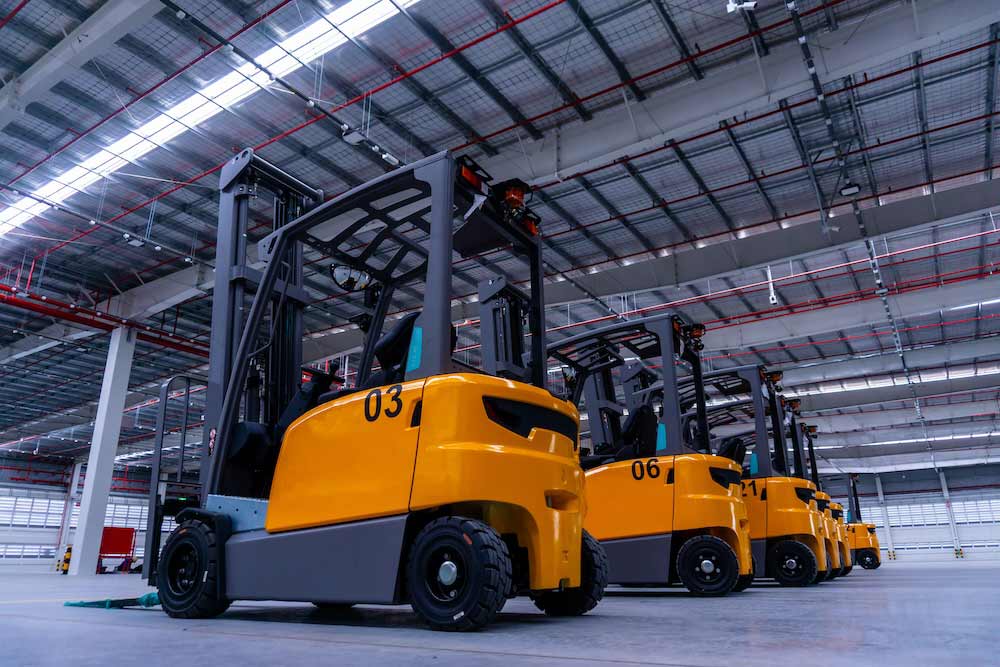
Electric forklifts run on battery power without requiring internal combustion fuel, resulting in zero engine noise, zero emissions, and no exhaust smoke. Equipped with compact engines, they can easily operate in narrow aisles and indoor environments. They are ideal for indoor facilities such as distribution centers, warehouses, food and pharmaceutical storage, as well as cold storage rooms.
Pros
- Cost-Effective : Eliminates the need for regular fluid changes such as engine oil, radiator coolant, or transmission fluid.
- Employee-Friendly : Operates quietly with zero soot or emissions, providing a healthier working environment.
- High Maneuverability : Compact body with a tight turning radius, ideal for confined spaces.
- Durability : Functions reliably in sub-zero temperatures, such as cold storage and freezing rooms.
- Easy Maintenance : Requires no petrol, diesel, or gas fuel systems.
Cons
- Requires regular battery charging after shift completions.
- Demands a dedicated charging station within the facility.
- A spare battery is recommended for continuous multi-shift operations.
- Requires a well-ventilated area for safe battery charging.
2. Internal Combustion Engine (IC) Forklift
Internal Combustion (IC) forklifts utilize traditional fuel engines powered by liquid fuels (diesel and petrol) or gas (CNG and LPG). These engines are highly durable, long-lasting, and deliver massive lifting capacities suitable for multi-ton loads. They are ideal for outdoor environments, such as open storage yards, seaport container yards, and heavy logistics centers.
Pros
- Continuous Long Hours : Can operate non-stop without downtime for battery recharging.
- Weather Resistant : Withstands extreme heat, rain, and dusty outdoor environments.
- Quick Refueling : Refuels rapidly to resume immediate operation.
Cons
- Engine noise and toxic exhaust emissions impact operator health and indoor air quality.
- Larger vehicle frame with a wide turning radius, making it unsuitable for narrow spaces.
- Subject to fluctuating and potentially rising fuel costs.
- Requires regular engine and mechanical maintenance.
3. Specialized Forklifts
- Rider Electric Counterbalance Forklift : Features front-mounted forks designed specifically for lifting and transporting pallets and general goods.
- Side Loader Forklift : Moves sideways to drive down narrow aisles, lifting and stacking goods directly onto racking without turning.
- Rough Terrain Forklift : Equipped with large, heavy-duty tread tires for gravel and uneven terrain, providing superior stability at construction and agricultural sites.
- Telehandler Forklift : Features a telescopic boom arm offering extended forward reach and high lifting capabilities, perfect for large construction sites and high-bay warehouses.
Key Factors in Selecting the Right Forklift
- Nature of Work: Evaluate required lifting capacity, working space, and ground surface conditions.
- Operating Location: Determine whether the forklift will be used indoors or outdoors.
- Budget: Compare prices across suppliers based on forklift type, lifting capacity, and specific functional features.
- Ease of Maintenance: Choose models with readily available, cost-effective replacement parts.
- After-Sales Service: Partner with suppliers offering comprehensive technical support, service centers, and experienced technicians.
Forklifts are essential labor-saving machines that enhance operational speed and efficiency. For business owners seeking top-quality forklifts, SIAM SUN offers zero-emission electric forklifts that operate quietly and energy-efficiently at competitive prices. We cater to businesses of all sizes with multiple models, backed by a 1-year or 2,000-hour warranty and ISO 9001:2015 certification. Furthermore, we maintain a complete spare parts center and 4 service branches across Thailand to deliver exceptional customer service.
For sales inquiries, contact Tel. 086-302-1778; Customer Service Tel. 086-307-1778, or connect via LINE: @siamsun
References
- 8 Different Types of Forklifts. Retrieved April 9, 2024, from https://www.nationalforkliftfoundation.com/8-different-types-of-forklifts/